Regional cross-border cooperation in the American Southern Cone seeks references in the Mediterranean Pyrenees
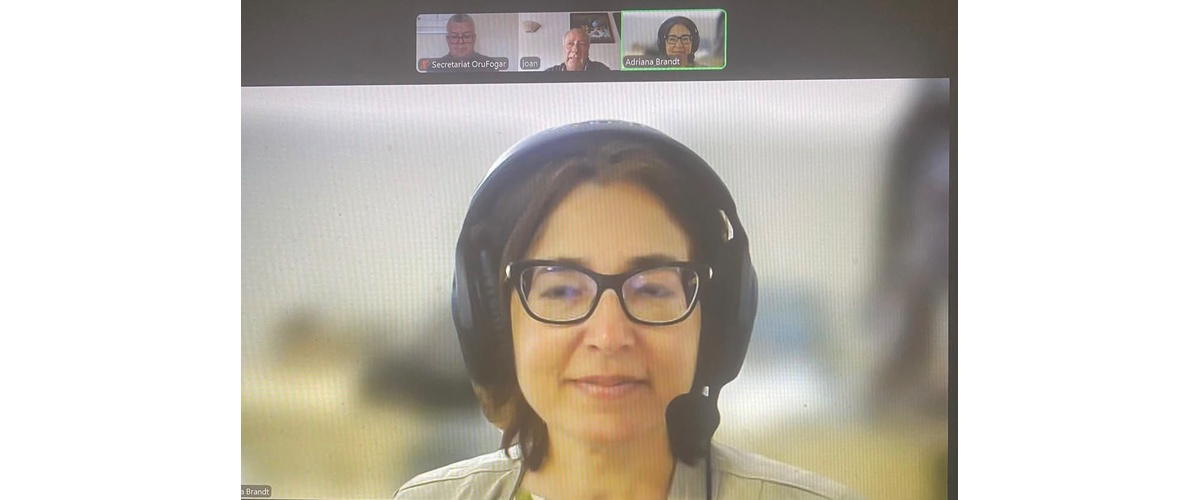
Cross-border cooperation and the joint management of shared territories by regional governments can constitute a fundamental pillar of development. A living example of this can be seen on the French-Spanish border in the Mediterranean Pyrenees, where a euroregion operates and where there are benchmark experiences such as the Cerdanya Hospital. It is not unusual, then, that NAPI Trinacional, a cross-border programme that brings together the state of Paraná (Brazil), the province of Misiones (Argentina) and the department of Alto Paraná (Paraguay), wished to learn about this experience. To that end, on 5 November, ORU Fogar organised a virtual agenda for the technical coordinator of NAPI Trinacional, Adriana Brandt, in which she met with key actors in the experience on the Mediterranean French-Spanish border.
NAPI Trinacional (Novos Arranjos de Pesquisa e Inovação - Região Trinacional) is an ambitious research, innovation and development platform promoted on the initiative of the state of Paraná (Brazil) —with the backing of the Araucaria Foundation— focused on the territory of the Triple Border. Thus, this programme, promoted and structured by regions, with the support of academia and civil society, aims to articulate a space for geopolitical cooperation. The main objective is to provide political and territorial decision-makers with information and proposals to build an integrated and operational territorial space.
In this territory, cross-border dynamics began with the construction of the Itaipú Hydroelectric Plant - the second largest in the world after China's Three Gorges - created by the 1973 Treaty as a binational condominium between Brazil and Paraguay with shared sovereignty and energy management, which Argentina joined in 1979, with an agreement to regulate the flow of the Paraná River. The cross-border experience, however, has not gone beyond the Plant and NAPI Trinacional now wants to promote it.
Before 5 November, the technical coordinator of NAPI Trinacional had already held working meetings with ARFE (Association of European Border Regions) and its secretary general, Martín Guillermo Ramírez. With this groundwork, Adriana Brandt was able to take part in several meetings that allowed her to learn first-hand about the experience of the Pyrenees-Mediterranean Euroregion and also of the Cerdanya Hospital.
One of the central axes of the working day was the meeting with Xavier Bernard-Sans, secretary general of the Pyrenees-Mediterranean Euroregion. Constituted under the legal form of a European Grouping of Territorial Cooperation (AECT), this entity brings together regional governments such as the Generalitat of Catalonia, the Occitania Region (France) and the Government of the Balearic Islands. Its fundamental purpose is to bring Europe closer to the territories through cooperation in cultural, environmental and economic matters and in the management of shared challenges —such as the ecological transition, water management or tourist pressure—, operating from the regions' own autonomy. Bertrán explained that the Euroregion's main successes are in the field of health, and here the reference to the aforementioned Hospital came up again; the universities and student exchanges among the three territories; innovation in various fields and the preparation of European-level projects. Adriana Brandt identified the possibility of drawing inspiration from the university exchanges which, in her case, are also an objective.
The next two meetings focused on cross-border health cooperation. Joan Carretero, mayor of Puigcerdà between 1995 and 2003 and the main political driving force behind the Cerdanya Hospital, and Xavier Conill, its current director, explained to Adriana Brandt the singularity of this unique project.
Inaugurated in Puigcerdà, the Cerdanya Hospital is the first publicly owned cross-border hospital in Europe integrated into a cross-border area. Jointly managed by the health systems of the autonomous government of Catalonia (CatSalut) and of the French Republic, this centre serves a binational population in a unified way, overcoming administrative, linguistic and legal barriers, and has become a world benchmark for the integration of essential public services driven by the territories.
With an interest in promoting similar initiatives on the Brazil-Paraguay-Argentina border, Joan Carretero advised the coordinator of NAPI Trinacional to be very persevering: “The difficulties in overcoming the administrative and mental barriers that borders impose are many. There are days when you are tempted to give up, but you have to carry on because the benefits of cross-border work are very great.” The former mayor also insisted that, in order to overcome the problems that politicians and bureaucrats may raise, practical solutions must be provided and the support of technical staff must be sought.
The Hospital's director, Xavier Conill, explained how a binational consortium had been set up, how a budget with Catalan and French contributions is managed, how divergent administrative, labour and accounting dynamics are overcome, and how the hospital is a laboratory where endless cross-border problems must be resolved.
In all the meetings, Adriana Brandt was told of the great importance of cross-border initiatives having broad political consensus that is sustained over time.