The ORU Fogar seminar in Romania highlights the right to live worthily in the rural world
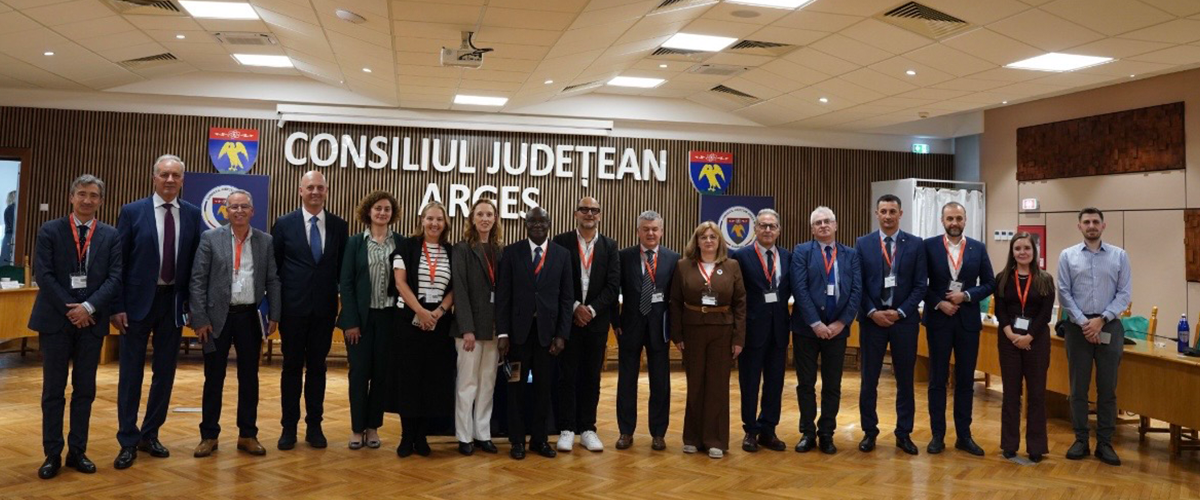
The seminar "Comparative Policies of Rural Development", organized by ORU Fogar on the occasion of the celebration in Pitești, Argeș, Romania, of its Executive Bureau, had a notable echo in the Romanian press, which devoted special attention to shared reflections by regional leaders from a wide variety of countries. All speakers called for the "right to live in dignity in the rural world", pointing out that the sustainability of nations depended on their ability to endow autonomy and resources throughout their territory.
The event was opened by the vice-president of the Argeș Departmental Council, Adrian Bughiu, who acted as host, along with representatives from the Romanian Ministry of Agriculture and the Chamber of Commerce of the Department.
The press highlighted the intervention of ORU Fogar’s Secretary–General, Carles Llorens, who explained that rural exodus continues to be a problem worldwide, but that "If in Europe it was a process that lasted two centuries or a few decades, now, on a continent like Africa, people move from living in the countryside to settling into cities massively within a few years." Llorens placed the debate in a strategic dimension, asserting that avoiding rural exodus is key to preventing the collapse of cities. He also explained that, in Africa, moving to the city is a first step to then emigrate –legally or illegally– to Europe. Thus, he denounced that centralism acts as a "disbalancing magnet," draining resources from territories to capitals. The proposed solution involved a polycentric state model based on effective decentralization and differentiated taxation that rewarded territorial resilience.
The seminar featured a rich plurality of interventions that provided solutions from different geographical contexts. On one hand, the Eastern Region of Morocco, represented by Salah el Aboudi, provided a strategic vision on how infrastructure investment and support for local economies were determinant in fixing the population to the territory. On the other hand, from Côte d’Ivoire, the Pr. Kadjo Kouame, from the Sud-Comoé Region, argued that a policy based on sustainable management and strengthening of social services stops the exodus. He emphasized that the creation of community schools prevents young people from leaving their communities.
From Europe, Rafael Hueso presented the experience of systemic transformation of the Basque Country, highlighting multi-level governance as a development engine. He said that the example of his territory shows that continuity of strategic policies is key, while having major agreements with all political and social actors. The Basque representative spoke of the two "great transformations" of his territory and as a bet like the Guggenheim Museum in Bilbao, he broke a negative dynamic of industrial decline, into a virtuous circle.
Martín Guillermo Ramírez, Secretary–General of the Association of Border Regions of Europe (ARFE), focused on cross-border rural development, pointing out that cooperation between neighboring regions is vital to overcome socioeconomic barriers. He pointed out that border regions, which are often distinctly rural, are critical to the European Union, as they concentrate one-third of its population and GDP. His proposal focused on the success of Interreg programs and the use of structural instruments (such as euroregions) to consolidate a cooperation that is not only economic but also citizen. In this sense, he put as an example of reference the Hospital de Puigcerdà, on the Franco-Spanish border. The ultimate goal, he said, is to use cross-border cooperation as a tool to eliminate inequalities imposed by borders, promoting diversified and sustainable rural development.
From South America, Daniela Andreia Schlogel, recently appointed executive secretary of ZICOSUR, highlighted the success of the state of Paraná (Brazil) in inter-institutional planning and support to family agriculture through rural credit. He generated the greatest interest when he explained how key to rural development in this Brazilian territory is the existence of cooperatives. The executive secretary of ZICOSUR explained the different work of large productive cooperatives, that of smaller local cooperatives, and the support given to them from the state of Paraná. He explained, for example, that school menus are made –basically– with products from small cooperatives.
The prefect of Azuay, Juan Cristóbla Lloret, presented, for his part, the management model that he leads in the Ecuadorian province as a development reference for Latin America. During his intervention, Lloret identified support for family farming as a central priority, directly linking it to a solidarity-based marketing network aimed at bridging the gap between rural and urban areas through storage centers and neighborhood shops. He also emphasized that the productive transformation of the Azuay is supported by the modernization of irrigation, promoting a transition to technologized and pressurized systems to ensure water sovereignty in the face of current climate challenges.
The local press highlighted the importance of Romania being the stage for this debate, especially given the demographic challenges facing its regions. The conclusions of the seminar reinforced the idea that rural development is not only an economic objective, but an exercise of democracy that required that power be close to the people, in order to offer precise solutions adjusted to the reality of the land. The event was also closed with a large consensus regarding how decentralization is essential to stop rural exodus.