Oru Fogar Secretary General Defends the Continued Relevance of Regionalism
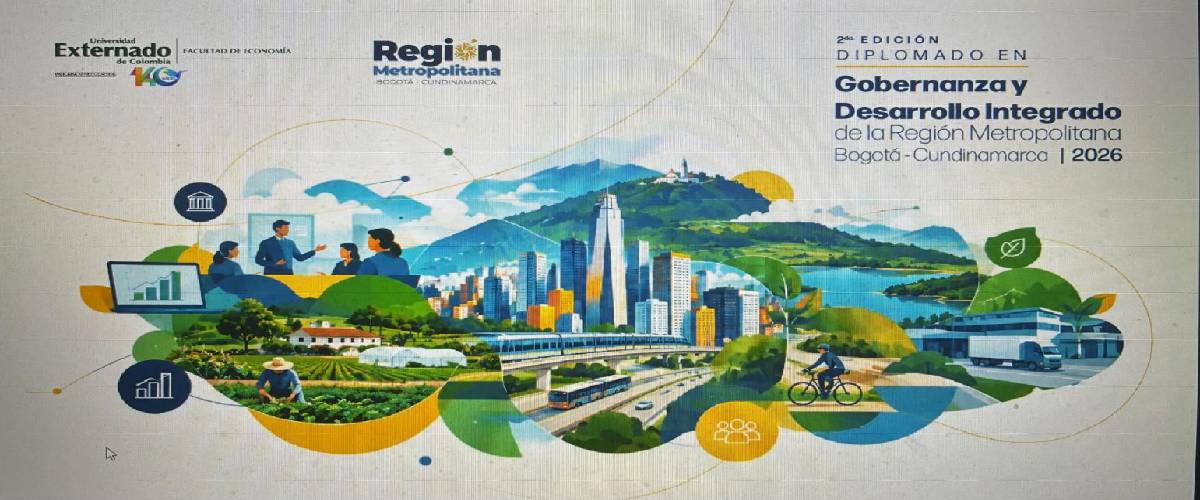
The Secretary General of the Organization of United Regions (Oru Fogar), Carles Llorens, inaugurated the diploma program in “Governance and Integrated Development,” organized by the Bogotá/Cundinamarca Metropolitan Region and the Universidad Externado de Colombia.
In his address, Llorens made a firm defense of the strategic role of regions, arguing that, unlike traditional political ideologies, which “can have great strength, but they pass,” regionalism “neither expires nor grows old.” In this regard, he stressed that “the desire to decentralize remains relevant no matter how many years go by.” The Secretary General of Oru Fogar summed up this territorial dynamic, as opposed to centralism, with a clear premise: “No decentralized country wants to return to centralism, but all centralized countries want to decentralize.”
To illustrate this principle, Llorens cited great benchmarks and models of historical success such as Switzerland, born as a confederation as early as 1291, or the United States (1776), whose federal system allows the harmonious coexistence of territorial, political and historical realities as diverse as California and Florida, or Massachusetts and Illinois. “Many issues can be debated about the United States, but not that its federal system has been a benchmark of longevity that continues to work,” he stated.
He also argued that a very substantial part of China’s emergence is due to the extraordinary power held by its governors. “The provinces,” he explained, “manage 24.80% of the country’s public resources. In addition, their governors manage a very significant share of the public enterprises that were previously controlled by the national Government, and they are the ones who promote their economy abroad. Today one could perfectly well speak of the United Chinese States. Its emergence has to do with how they have managed the transition of their economic system from communism to State capitalism, but also with their bold commitment to decentralization.”
Llorens likewise referred to the process begun in Spain from 1978 onwards, describing as a “historic success” the model that granted autonomy and self-government to all its regions. However, he warned that decentralization must be understood as “a living process conditioned by the political history of each country,” but one that responds, in every geography, to certain constants that involve continuous tensions and debates over the allocation of powers and the distribution of economic resources.
In the final part of his presentation, Llorens cited Eduardo Verano, Governor of the Department of Atlántico (Colombia), as one of the leading figures of regionalism. The Secretary General and the Governor had met a few days earlier in Madrid to discuss the progress of the decentralization process in Colombia and the establishment of the Caribbean Territorial Entity Region (RET). At that meeting, Llorens conveyed to the Governor the formal invitation of the President of Oru Fogar, Rachid El Abdi, to become more closely involved in the organization and to become, through this international platform, one of the leading voices of regionalism in Latin America.